Technical Note
An Advanced Random Shaker Control Algorithm
The Advantages Offered by the High Performance of SD2550 Shaker Control Systems
Overview
Closed-loop random Shaker Control
algorithms used by SD2550 Systems employ both feed-back and feed-forward
control error correction processes. Feed-forward processing speeds
the control correction rate without compromising overall control
stability. The control algorithms are also adaptive in nature.
This allows the control system to follow changes in the dynamic
characteristics of the test article.
Separate control loops are dedicated
to controlling the shape of the drive spectrum and the overall
RMS response at the control point(s). Coordination of these control
loops results in an error spectrum that is symmetric, in the least-squares
sense, in the control frequency range. The SD2550 control loop
design represents an advancement of the state of the art, in vibration
control, as compared to other available control systems.
An Advanced, Adaptive Control Algorithm
Design of the SD2550 closed-loop control
algorithms incorporates methods and parameters to minimize both
control errors and the time the control system takes to achieve
stable control. Control errors are caused by discrepancies between
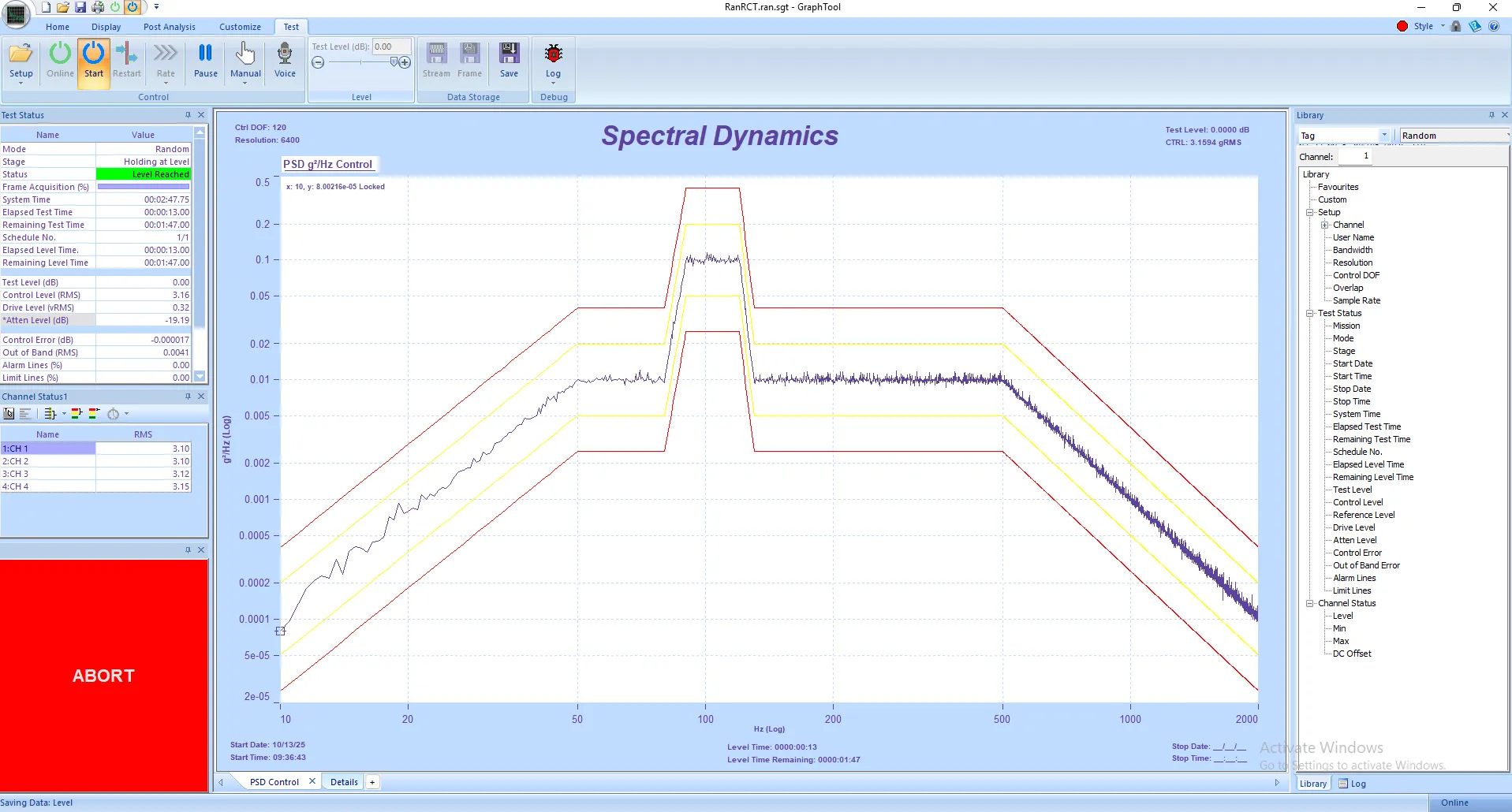
the Power Spectral Density (PSD) of the Control-Response acceleration
signal, C(f), and a user defined Reference PSD, R(f).
To optimize both the system's control
speed and loop stability, the control methods employ both feed-back
and feed-forward error correction. Maximizing control speed and
control stability requires proper coordination between these two
control processes.
This combination of feed-back and feed-forward
control processes, known as a Proportional-Integral-Derivative
(PID) control process, allows the control loop to use larger feed-back
gains. This design provides a very fast control process without
compromising the overall control loop stability. PID control processing
is a level of design sophistication not available with other vibration
control systems.
The block diagram shows the control
loop processing used in SD2550 Systems.
Control Loop Block Diagram
Feed-Back Control Loop Processing
The feed-back portion of the control-loop
consists of measuring the error-spectrum ( E(f)=R(f)/C(f) ) as
well as the RMS error (the ratio of the Reference RMS and the
Control Response RMS). A portion of this error spectrum is added
to the current Drive Spectrum to produce the Drive Spectrum for
the next control loop iteration. Also, a portion of the RMS error
acts on the output attenuator to quickly adjust the overall level
of the drive spectrum. The control Degrees-of-Freedom (DOF) selected
in the setup parameters determines the proper proportions of these
two error correction terms.
Feed-back gain "a"
governs the update rate for the drive spectrum. Feed-back gain
"ß" governs the rate of change for the drive signal
overall-amplitude. These feed-back gains are automatically calculated
by the control system software. Properly choosing values for these
gains, "a"
and "ß", insures a responsive and stable control
loop.
Feed-Forward Processing for Responsive
Control
Feed-forward processing maximizes the
control system's responsiveness to sudden changes in the overall
level. The control loop uses feed-forward to "anticipate"
changes in the overall control level based on the derivative of
the RMS error. The control loop calculates this derivative by
monitoring changes in the Control Response RMS between control
loop iterations.
The feed-forward process mitigates the
negative effects of the exponential averaging technique used to
estimate the instantaneous Control Response PSD. This exponential
averaging estimator acts like a low-pass filter that injects delay
into the control loop iteration. Without a feed-forward, or derivative
term, in the control process, control performance is degraded
as the feed-back gains must be reduced to insure the stability
of the control loop. Reducing the feedback gains lengthens the
time required to fully correct errors in the Control PSD as smaller
changes are made to the Drive PSD each loop iteration.
Without this feed-forward processing
the time to re-equalize changes to the load dynamics can be unduly
long. Test article exposure to high excitation levels results
in either a overtest condition or damage to the test article.
An example of this problem is the testing of devices with valves
that actuate during a test. Closure or opening of a valve, during
a test, results in a sudden change to the structural dynamics
as the valve seats or unseats. Resonant frequencies shift, as
the valve seats or unseats, causing over excitation at the new
resonant frequencies until the control system re-equalizes. Feed-forward
processing allows the control system to adjust to the change in
structural response much faster than is possible if adjustments
are based solely on spectral averaging in the main feed-back loop.
Inherent Control Stability
Design of the feed-back and feed-forward
control loop structures limits control loop overshoot to no greater
than 10% of the amplitude step or 1.25 dB, whichever is smaller.
This enhanced stability, unique in the industry, allows the system
to control effectively and in a stable manner even in the presence
of non-linear loads. It eliminates wild loop-to-loop amplitude
changes when controlling non-linear shaker systems or test articles.
In fact, every day testing often demands compensating for the
non-linear behavior of hydraulic shakers, or electro-dynamic shakers
with hydraulic slip-tables, or complex structures.
Competitive systems do not provide this
level of control system design. These systems use an older technique
with fixed feed-back gain and no feed-forward processing. For
these systems, the control system's stability depends on the operator's
selection of "N" and "K" parameters. "N"
represents the number of spectral averages per loop. "K"
sets the exponential discount factor for averaging the control
spectrum. These "N" and "K" parameters directly
determine control spectrum DOF but indirectly affect the stability
of the control system.
Larger values of "N", for
a fixed DOF, reduce the effective feed-back gain of the control
system, thus making the control system more stable but less responsive.
The SD2550 control algorithm, on the other hand, attacks the stability
problem directly. Values of the feed-back gains "a"
and "ß" are designed to insure stable control
loop behavior for all settings of control DOF. This eliminates
the need for separate "N" and "K" parameters
as operator adjustable parameters. The control system internally
calculates the values of "a"
and "ß" using a design formula that insures stable
and fast control loop operation.
Superior Control Accuracy and Output
Signal Generation
The Drive Spectrum shape results from
the error between the Reference Spectrum and Control Spectrum.
Amplitude normalization of the Drive Spectrum allows the resultant
time-domain drive signal to use the maximum dynamic range available
from the 16-bit DAC (Digital to Analog Converter). A 24-bit voltage
attenuator sets the full-scale voltage level of the DAC. The attenuator
allows the SD2550 to adjust the full-scale output voltage range
in steps as fine as 0.1 dB. Fine output adjustment capability
provides accurate control at both full and low test excitations
levels. Also, the attenuator allows the RMS feed-back loop to
adjust the Drive's RMS level without changing the shape of the
Drive's Spectrum.
Output signal generation algorithms
use time-domain randomization to generate a drive signal free
of any discontinuities. Four-to-one overlap processing in the
randomization processing optimizes the Gaussian purity of the
drive signal. Output smoothing filters protect against out-of-band
frequency content and harmonic distortion in the drive signal.
Implementation of this sophisticated
design requires high-performance control system hardware. The
SD2550 architecture employs multiple, high-speed processors and
distributed processing to meet this computational demand.
Conclusion
SD2550 Control Systems feature an advanced
adaptive random Shaker Control algorithm. This algorithm computes
an adapting frequency response estimate of the test article dynamics.
Based on this estimate, the control algorithm compensates for
the dynamics of the test article to give the desired test spectrum.
Feed-forward processing allows the system to track sudden changes
in the overall level, minimizing the chances of an over-test condition.
Further, the SD2550 multi-processor architecture and distributed
processing provide superior control loop performance and safety.
|