Spectral Dynamics Inc.
  • Home
    • About SD
    • History of Spectral Dynamics
  • Shakers

    Shakers

    • Overview
    • Water Cooled
    • Air Cooled
    • Vibration Shaker Systems Buyer's Guide

    Options

    • Slip Tables & Head Expanders
    • Shock Test Machines
    • Hydraulic Exciters
  • Vibration Controllers

    Multiple/Single Axis

    • Jaguar™

    Single Axis

    • Panther
    • Puma™
    • Lynx™
  • Advanced Solutions

    ARPG Products

    • SIPS™
    • VIDAS™
    • IMPAX-SD-LAB™

    P.I.N.D. System

    • Felix™ Computer Aided Test System

    Advanced Solutions

    • BalanceTool™

    High Speed Data Acquisition

    • VIDAS™

    Data Analysis

    • CATS™
    • STAR Modal™
    • STAR Acoustics™
  • Support

    Service & Information

    • Vibration Control Buyer’s Guide
    • Request Product Information
    • Contact SD
    • Customer Training
    • Domestic US Service

    Software Support

    • Panther Software Tutorials
    • Spectral Dynamics Software FAQs
    • CATS / STAR Modal™ Help

    Additional Support

    • Related Links
    • Technical Library
    • Spectral Dynamics Vibration Calculator
Panther Replication · MIL-STD-810H Method 519.8

Gunfire shock, replicated and proven.

Panther Replication now runs 519.8 gunfire tests end to end. A 1.5 ms monitor can stop a bad test on the standard's own criterion. A nine-check verdict scores the result, and the report shows where every check stood.

Talk to us about gunfire See the results
SHORT-TIME RMS ERROR · % of peak · 1.5 ms windowsexample
024560 s5 s10 s15 s20 sALARM 4 %ABORT 5 %6.00 % at 10.001 s: stopped

ABORTED · Peak Abort Level Exceeded. [810H 519.8 check P1: short-time RMS error 6.00% of peak at 10.001 s]

Why gunfire is hard

A hundred pulses a second, judged 1.5 ms at a time

At 6,000 rounds a minute a gun puts 100 pulses a second into the airframe. Method 519.8 judges the replay window by window: the short-time RMS error must stay under 5 % of peak in every firing window a tenth of a pulse long. That breaks the usual tools.

frame ≈ 16 pulses

Frame-level monitors are too coarse

A typical error check averages a quarter-second frame. One bad pulse passes unseen.

13,000+ windows in 20 s

Plots can contradict the verdict

Average or skip samples to fit a screen and the one violating window disappears.

525.2: keep the traces

The standard asks for evidence

Reference, control and drive must be kept and reported. A pass light isn't enough.

And sine-on-random is not an option: 519.8 states it is no longer permissible for gunfire.

What's new in Replication

No new application. A much stronger Replication.

Gunfire runs on Panther Replication, the Time Waveform Replication controller labs already use. The new capability sits around it, before, during and after the test.

Before

The reference

  • Field recordings replay as a stream file (Procedure I).
  • WaveGen writes a 519.8-checked time history when nothing was measured (Procedure III).
During

Watch every window

  • 1.5 ms short-time RMS monitor on every frame.
  • Alarm and abort on the P1 quantity, with the reason named.
  • Error-vs-time display, worst window per column, limit lines drawn.
  • Drive clip counter.
  • Cleaner drive: buffer-joint glitch fixed, 18.1 % → 0.4 %.
After

Score it and show it

  • The 519.8 checker: all nine tolerances on the firing windows.
  • A verdict at the end of the run.
  • A report with plots that hide nothing.
  • ASCII export of reference, control and drive (525.2).
Three ways to a reference

Whatever data your program has

ProcedureWhenThe reference
I · Measured time historyField recordings exist. Recommended whenever they do.The recording, replayed as a Replication stream file
II · SRS-generated pulseOnly a shock response spectrum survives.A pulse synthesized to the SRS, repeated at the firing rate
III · No field dataNothing measured. For preliminary design.WaveGen predicts the Annex C spectrum and writes the time history, with the plays per axis

All three end the same way: a time history replayed under Time Waveform Replication and judged by the same nine checks.

PASS  –  MIL-STD-810H 519.8

F-16 / M61A1, 6000 rds/min, 1 m · resonant fixture

CheckCriterionMeasuredResult
A1STARMS within 1 dB, ≥ 90 % of windows100 %PASS
A2correlation ≥ 0.90, ≥ 90 % of firing windows100 %PASS
A3error STARMS ≤ −15 dB, ≥ 90 % of windows100 %PASS
A4error tails ≤ 12.2 % of extreme peaks0.64 / 0.55 %PASS
P1error STARMS < 5 % of peak, every firing window100 % · margin 23.0 dBPASS
P2per-pulse peaks within 10 %100 %PASS
P3ESD ±3 dB, ≥ 90 % of lines100 %PASS
P4ASD ±3 dB, ≥ 90 % of lines100 %PASS
P5overall RMS within 10 %0.3 %PASS
Monitorworst window 0.359 % of peak · no alarm
Drivepeak 10.4 % of limit · 0 clipped

Values from a verification run on the simulated test system (Repl10).

The verdict and the report

Nine checks, and where each one stood

At the end of every run Replication scores the firing windows against the nine 519.8 tolerances: four from Annex A (A1–A4) and five from §4.2.1 (P1–P5).

  • The verdict: a banner, then each check with its criterion, measured value and PASS or FAIL.
  • What happened in the test: how it ended, the monitor's worst window, alarms, clipped samples.
  • Seven plots built not to hide anything: error against time (peak-preserving), exceedance, the worst-window zoom, per-pulse peaks, ESD, ASD and the error distribution.
  • The detail files: per-window and per-pulse numbers and the exported traces.
The evidence

28 gunfire tests. Nine checks each. All passed.

Verified on Panther's simulated test system with a resonant fixture whose modes sit inside the gunfire band (420, 780, 1,350 and 2,800 Hz). Each dot is one test: its firing rate, and how far its worst 1.5 ms window stayed inside the P1 limit.

051015202530351,0002,0003,0004,0005,0006,000P1 limitRepl10: M61A1 6000 rds/min, 1 m: 23.0 dBRepl15: GAU-2B/A 6000 rds/min, 1 m: 24.1 dBRepl21: M61A1 6000 rds/min, 1 m: 24.2 dBRepl16: GAU-2B/A 6000 rds/min, 3.5 m: 24.2 dBRepl19: M61A1 4000 rds/min, 1 m: 24.5 dBRepl23: M61A1 5000 rds/min, 1 m: 24.6 dBRepl08: M61A1 6000 rds/min, 3.5 m: 24.6 dBRepl13: GAU-8/A 4200 rds/min, 1 m: 25.0 dBRepl27: M39 3000 rds/min, 1 m: 25.9 dBRepl22: M61A1 6000 rds/min, 3.5 m: 26.4 dBRepl24: M61A1 5000 rds/min, 3.5 m: 26.4 dBRepl31: GAU-2B/A 3000 rds/min, 1 m: 26.7 dBRepl25: M39 3000 rds/min, 1 m: 26.9 dBRepl17: MK12 1000 rds/min, 1 m: 27.2 dBRepl20: M61A1 4000 rds/min, 3.5 m: 27.4 dBRepl11: GAU-8/A 2100 rds/min, 1 m: 27.6 dBRepl33: AN-M3 1200 rds/min, 1 m: 27.9 dBRepl14: GAU-8/A 4200 rds/min, 3.5 m: 28.0 dBRepl30: GAU-8/A 2400 rds/min, 3.5 m: 28.0 dBRepl26: M39 3000 rds/min, 3.5 m: 28.2 dBRepl32: GAU-2B/A 3000 rds/min, 3.5 m: 28.2 dBRepl29: GAU-8/A 2400 rds/min, 1 m: 28.2 dBRepl28: M39 3000 rds/min, 3.5 m: 28.3 dBRepl34: AN-M3 1200 rds/min, 3.5 m: 28.9 dBRepl12: GAU-8/A 2100 rds/min, 3.5 m: 28.9 dBRepl18: MK12 1000 rds/min, 3.5 m: 29.3 dBRepl09: MK12 1000 rds/min, 2.5 m: 29.6 dBRepl07: M61A1 6000 rds/min, 3.5 m: 32.7 dBP1 margin: worst window below the 5 % line (dB)firing rate (rds/min)
1 m from the muzzle2.5 m3.5 m27 on the resonant fixture, 1 on a stiff mass
28 / 28

gunfire tests with all nine checks passed: eleven aircraft and gun pods, 1,000–6,000 rds/min

23–33 dB

P1 margin in the worst short-time window

10.001 s

a seeded 6 % error stopped the test, with the reason named

Identical

C++ checker vs the independent Python reference, every case

Beyond gunfire

Better Replication for every test

The monitor, clip counter, export, checker, verdict and report were built for gunfire, but they serve any Replication test. Together they form the core of a Method 525.2 Time Waveform Replication compliance package: a short-time error monitor with alarm and abort, a display that can't hide a bad moment, a record of clipped drive, the exported traces 525.2 asks for, and a scored, documented result.

Who it's for

Labs that have to prove it

  • Defense and aerospace labs with a 519.8 requirement, with or without measured data.
  • Programs qualifying materiel near aircraft guns: pods, avionics, stores, mounts.
  • Any Replication user who needs to show a replay met its tolerances, not just that it ran.
  • Quality and compliance teams who need a report that stands up to review.
Questions

Frequently asked

Is gunfire a new Panther application?

No. Gunfire runs on Panther Replication, the Time Waveform Replication controller labs already use, with a new short-time monitor, checker, verdict and report around it.

What if we have no measured gunfire data?

Method 519.8 Procedure III covers that case. WaveGen predicts the Annex C spectrum, writes a checked time history and gives the number of plays per axis for Replication.

Can sine-on-random be used for gunfire?

No. Method 519.8 states that sine-on-random is no longer permissible for gunfire.

Does the new capability help other Replication tests?

Yes. The monitor, clip counter, export, checker, verdict and report serve any Replication test and form the core of a Method 525.2 compliance package.

Replicate gunfire, and prove it.

Gunfire testing runs on Panther Replication with Spectral Dynamics Panther controllers.

Talk to us

Panther Applications


  • Panther – Field Data Vibration Test Replication Software
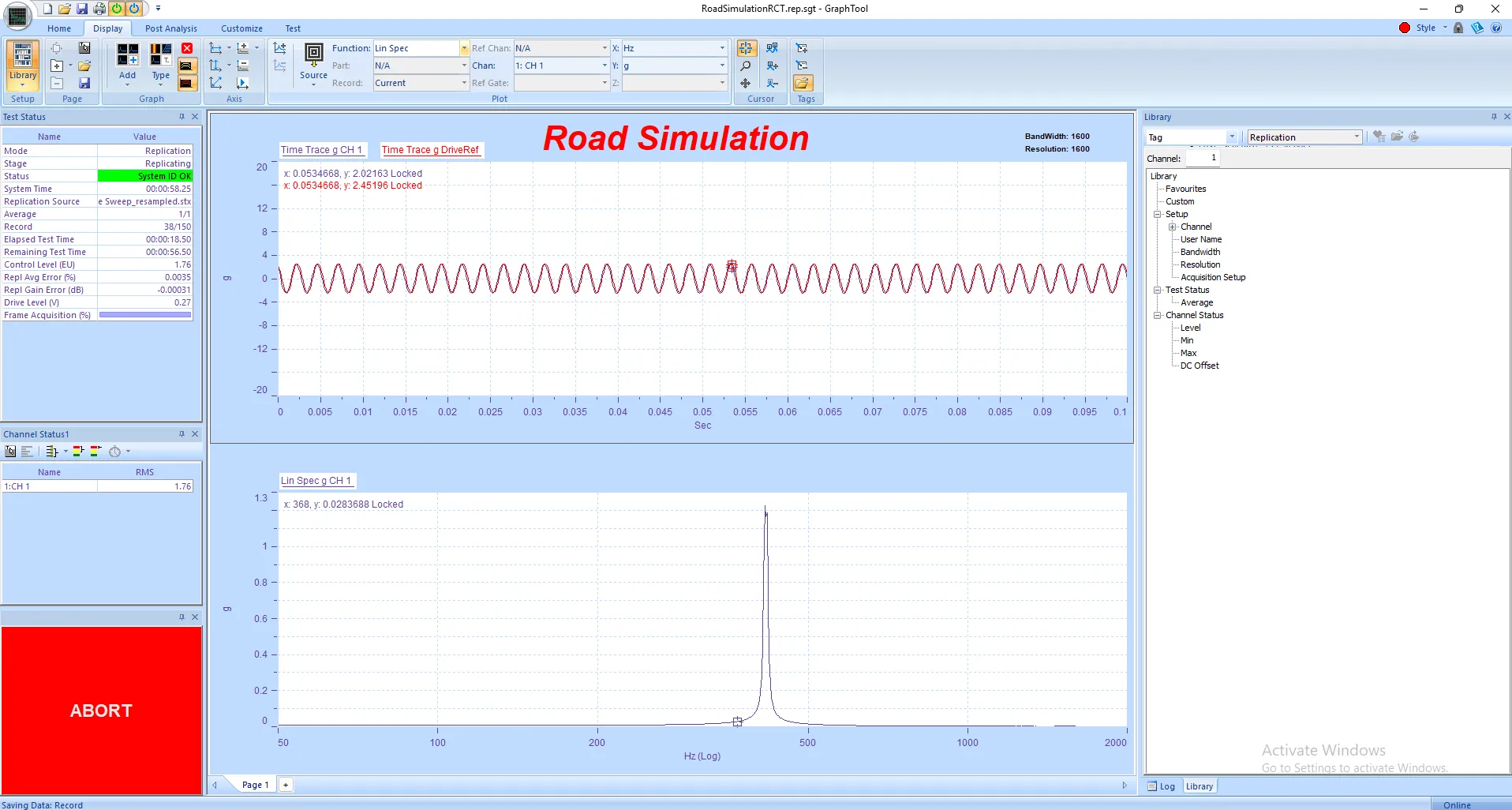
    Panther Field Data Replication makes it possible to reproduce actual measured time history vibration data in the laboratory on a shaker system.

    Panther Field Data Replication Control delivers precision and performance in time-domain waveform...

  • Panther Analyzer – Vibration & Modal Analysis Software

    Panther Analyzer is a next-generation platform with advanced tools for vibration and modal analysis.

    Panther Analyzer extends the power of Spectral Dynamics' next-generation Panther platform with...
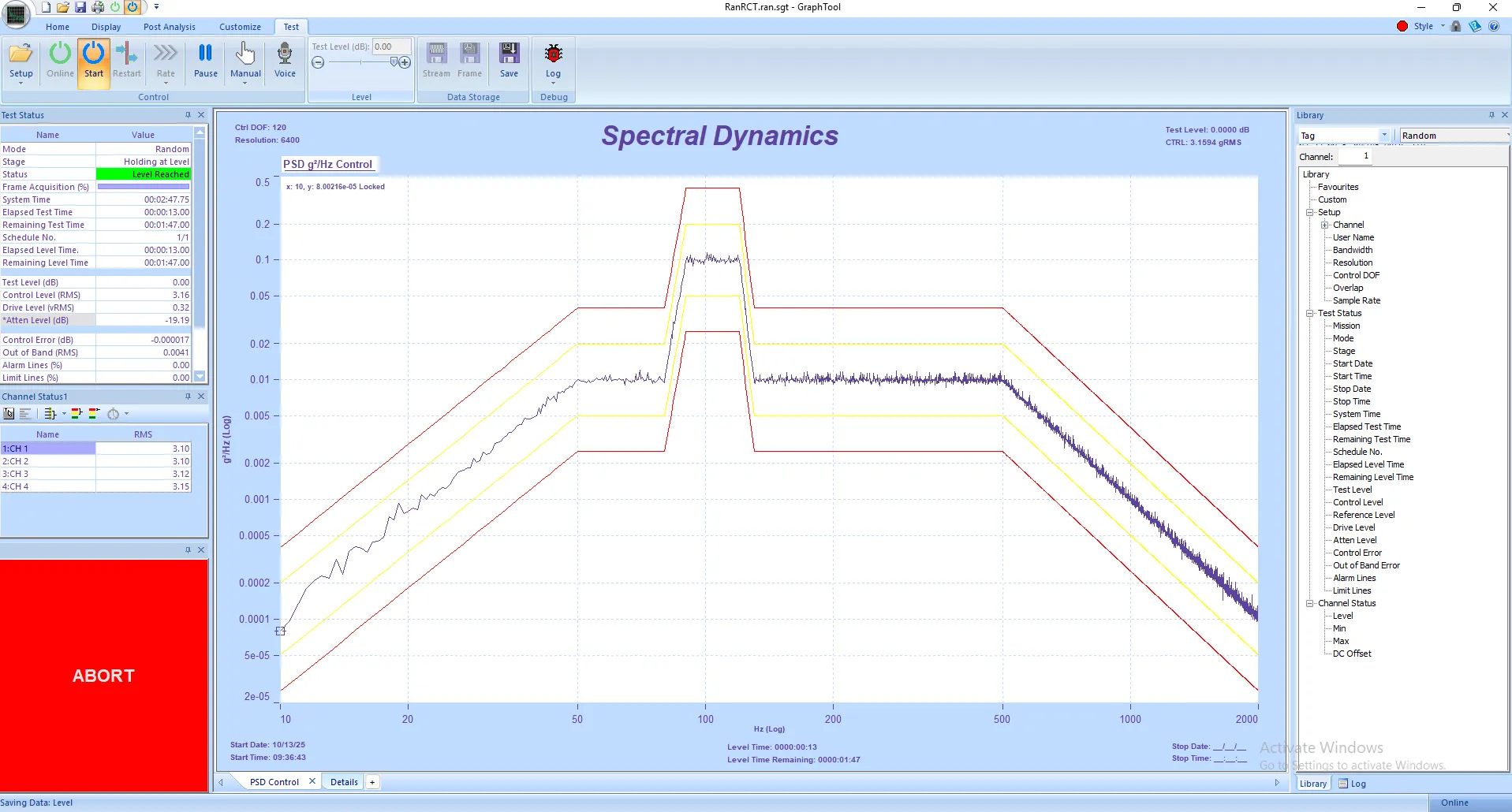
  • Panther Random – Random Vibration Control Software

    Panther Random Vibration Testing software with precise control and reliable test results. Analyze real-time random data or from recorded data.

    Spectral Dynamics invented closed-loop digital vibration control and continues to lead with...
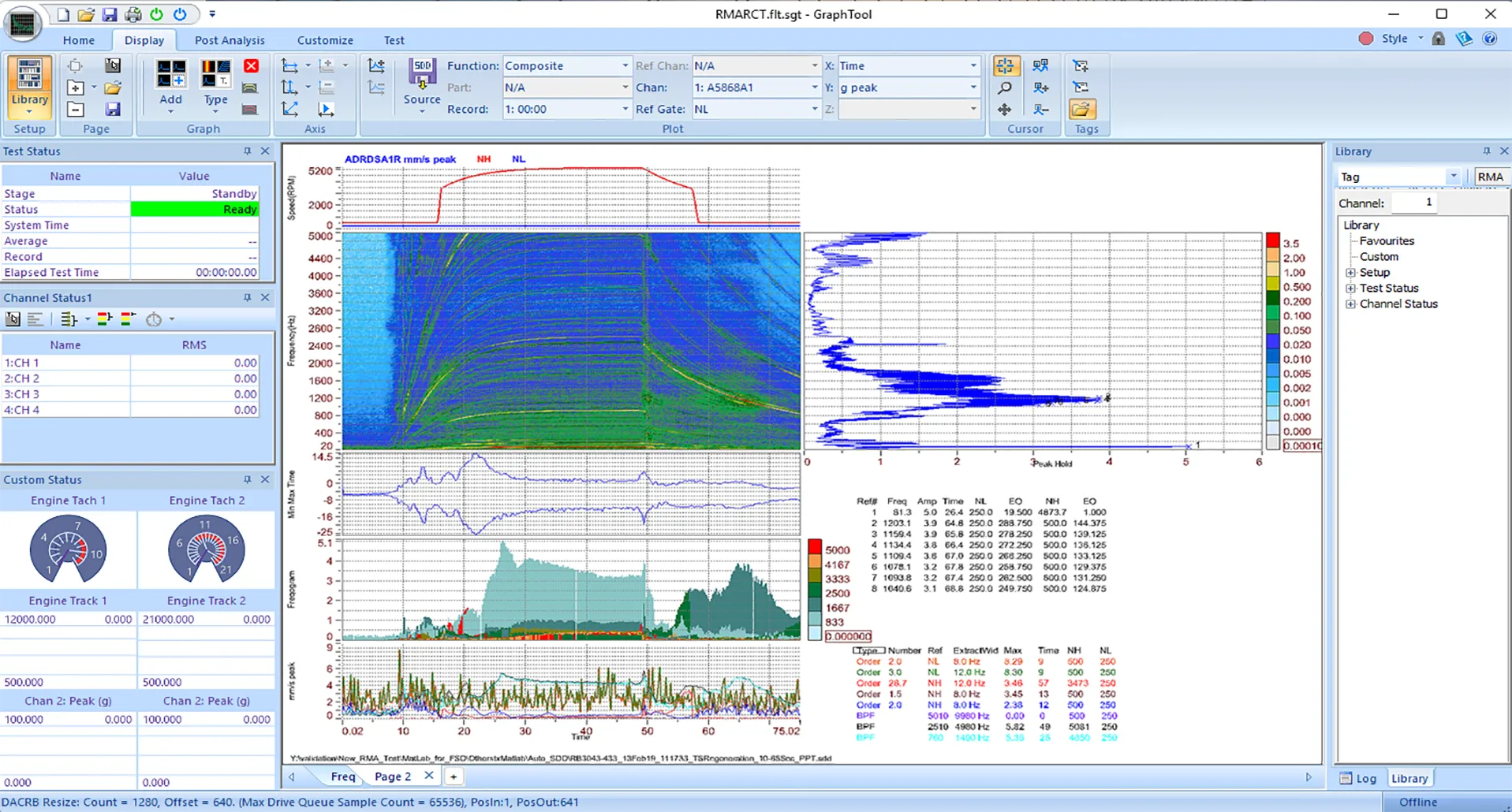
  • Panther RMA: Rotating Machinery Analysis & Diagnostics

    Panther Rotating Machinery Analysis allows users to examine steady-state operation and dynamic speed variations of rotating equipment with complete signal fidelity.

    Spectral Dynamics invented closed-loop digital vibration control and continues to innovate with...
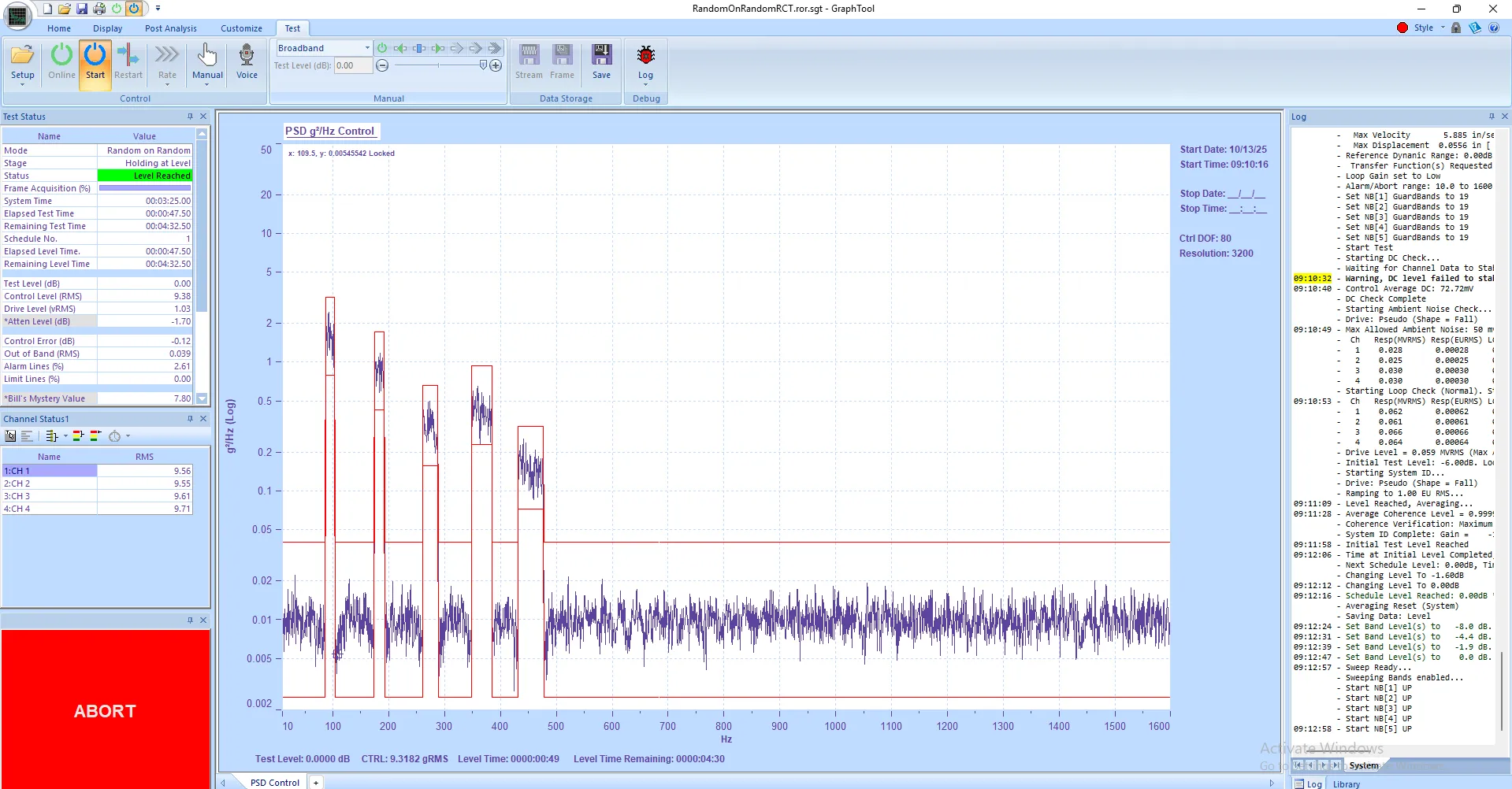
  • Panther ROR – Random-on-Random Vibration Test Control Software

    Panther Random on Random enables simultaneous control of multiple independent random vibration sources, providing accurate broadband spectral control.

    Panther Random on Random Control delivers precision and performance in multi-environment vibration...
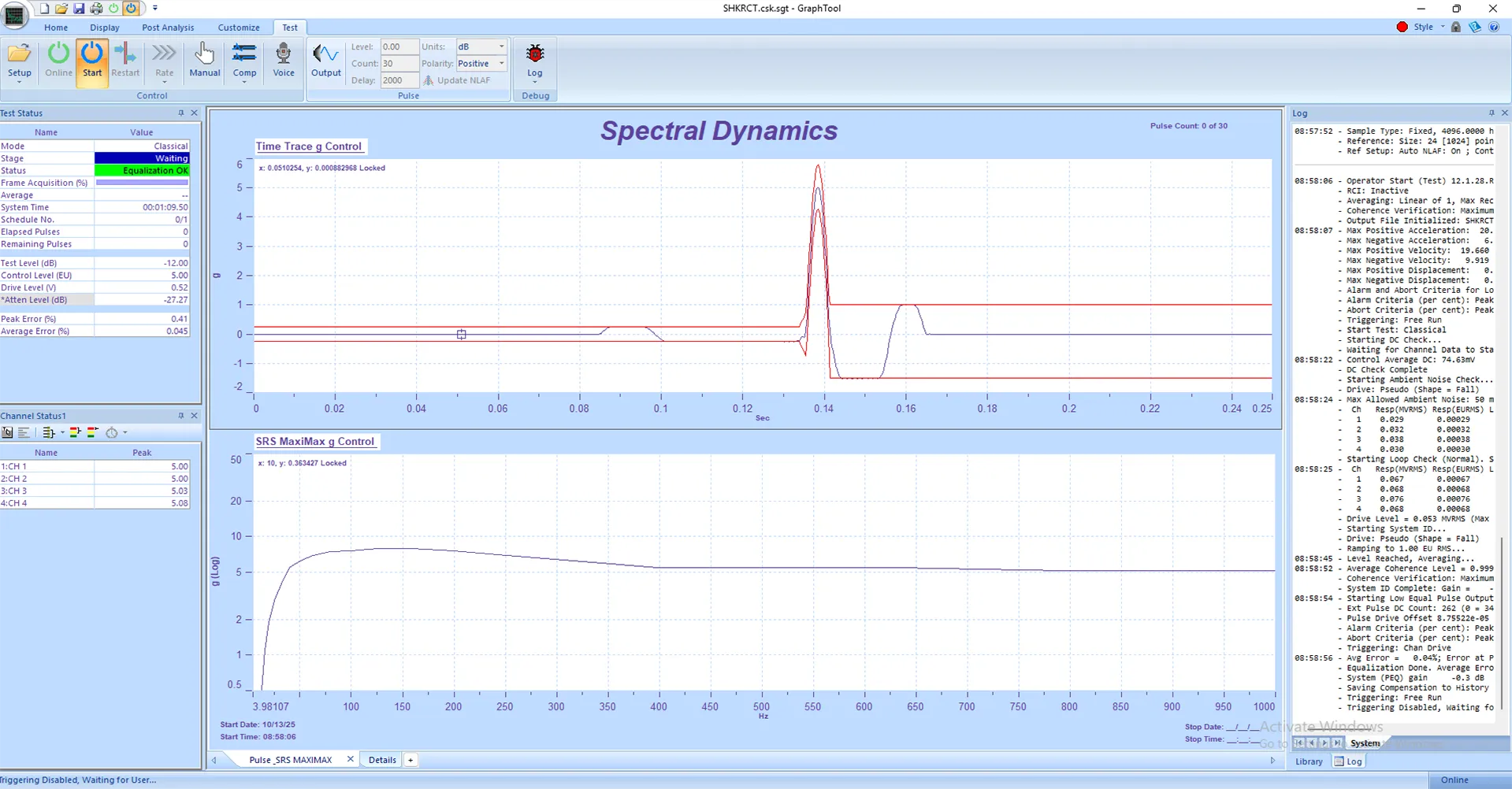
  • Panther Shock – Shock Testing Vibration Control Software

    Panther Shock Control delivers precision and performance in transient vibration testing that ensure safe and accurate shock reproduction.

    Panther Shock Control delivers precision and performance in transient vibration testing. Built on...
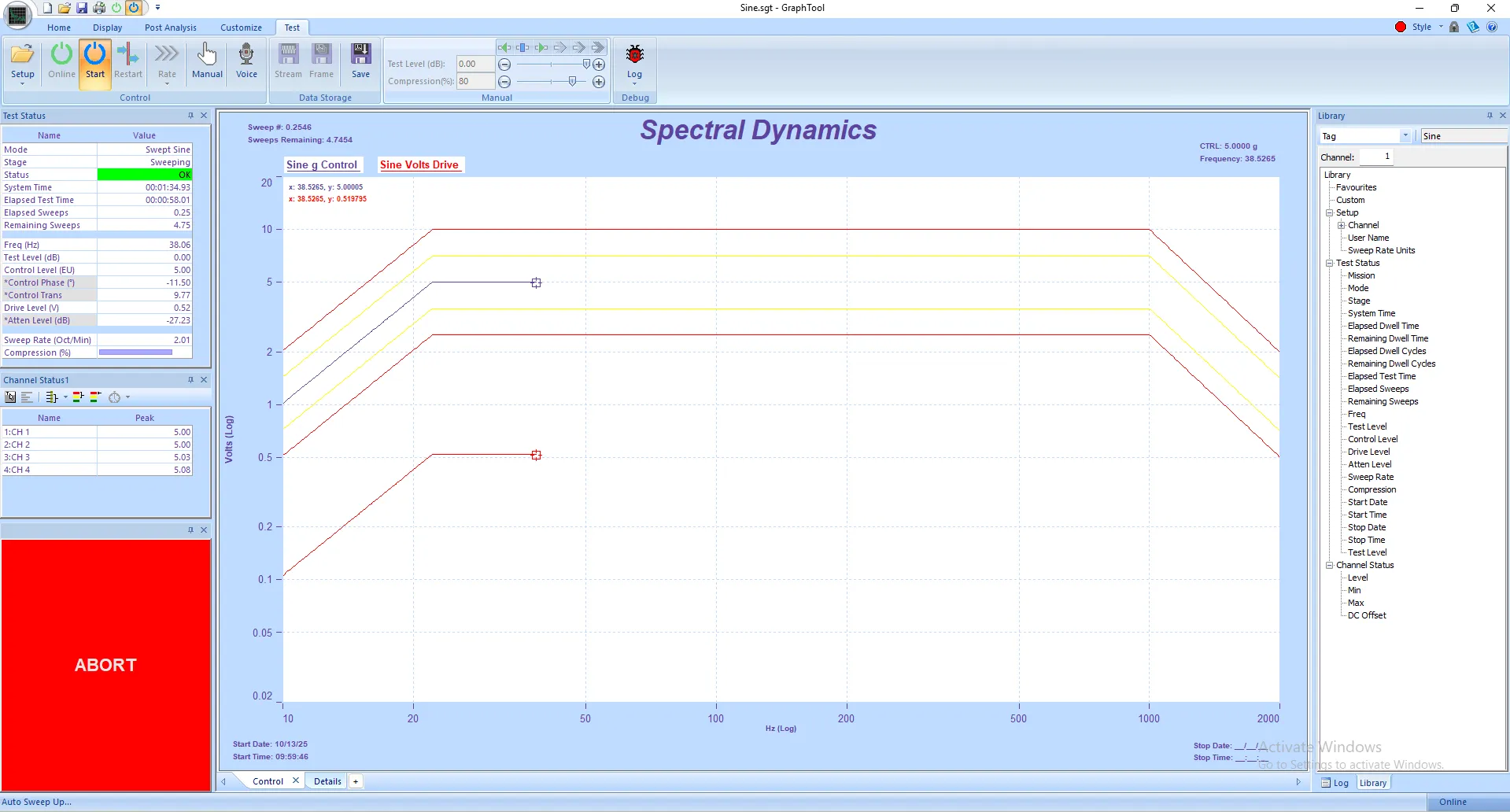
  • Panther Sine – Sine Vibration Control Software

    Panther Sine Control delivers unmatched precision and stability for both swept-sine and stepped-sine vibration testing.

    Panther Sine Control delivers unmatched precision and stability for both swept-sine and...
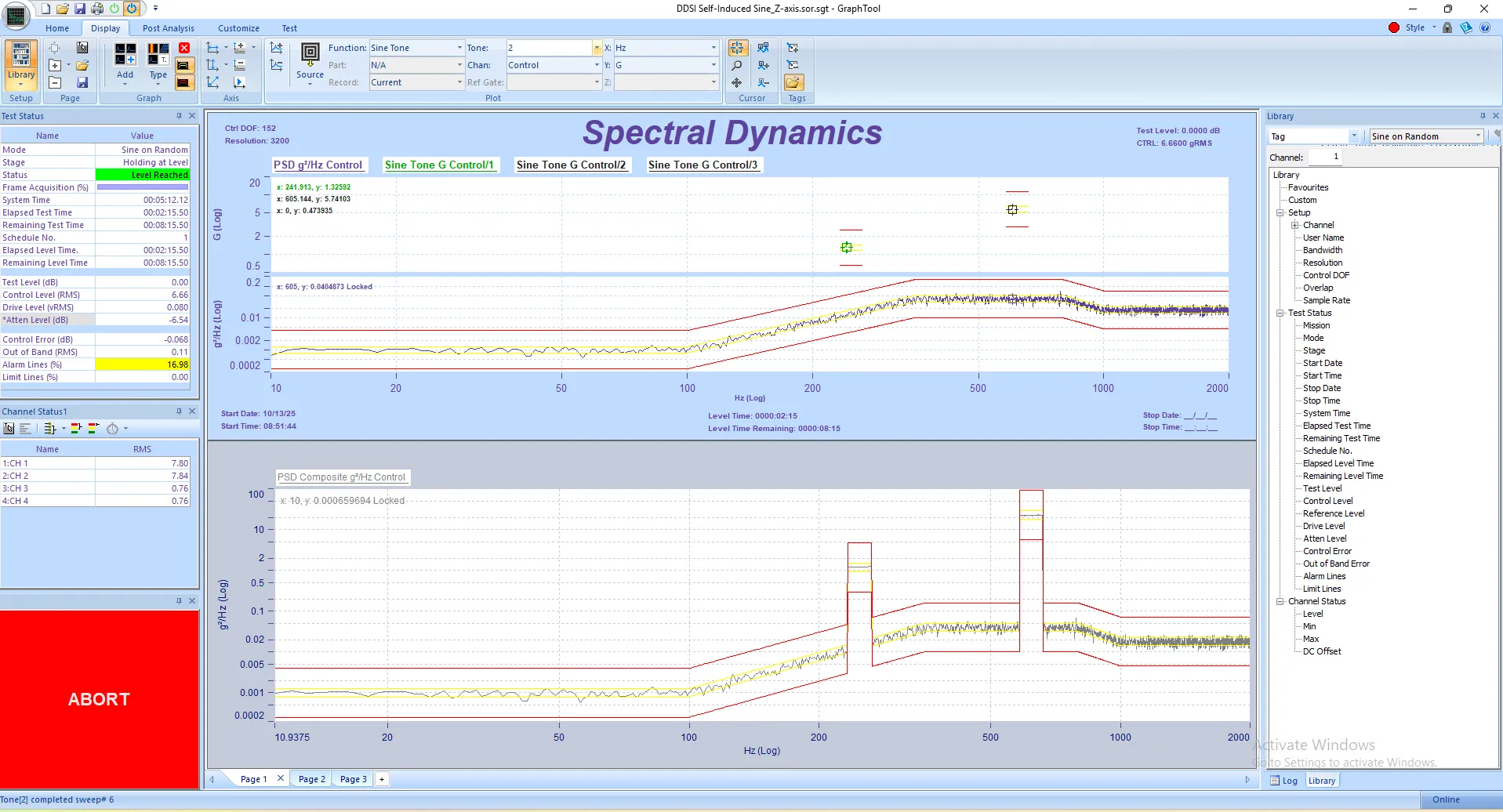
  • Panther SOR – Sine-on-Random Vibration Control Software

    Panther Sine on Random enables simultaneous control of multiple independent sine tones and random background vibration sources for accurate broadband spectral control.

    Panther Sine-on-Random Control delivers precision and performance in mixed-mode vibration testing....


Spectral Dynamics, Inc. is a leading worldwide supplier of systems and software for vibration testing, structural dynamics, and acoustic analysis. Spectral Dynamics' products are used for design verification, product testing and process improvement by manufacturers of all types of electronic and mechanical products.

1500 Wyatt Drive Suite 14
Santa Clara, CA 95054-1522
Tel: (800) 778-8755
sales@spectraldynamics.com
service@spectraldynamics.com

Vibration Controllers

  • Panther  
  • Lynx  
  • Puma  
  • Jaguar

Advanced Solutions

  • Felix - P.I.N.D.

Support

  • Contact
  • Product Information
  • Domestic U.S. Service

© 2026 Spectral Dynamics Inc. Privacy Policy

Download our ISO 9001:2015 certificate | Sitemap

Link to Spectral Dynamics LinkedIn PageLink to Spectral Dynamics Facebook PageLink to Spectral Dynamics Google results.Link to Spectral Dynamics Youtube Page