
Spectral Dynamics Inc.
  • Home
    • About SD
    • History of Spectral Dynamics
  • Shakers

    Shakers

    • Overview
    • Water Cooled
    • Air Cooled
    • Vibration Shaker Systems Buyer's Guide

    Options

    • Slip Tables & Head Expanders
    • Shock Test Machines
    • Hydraulic Exciters
  • Vibration Controllers

    Multiple/Single Axis

    • Jaguar™

    Single Axis

    • Panther
    • Puma™
    • Lynx™
  • Advanced Solutions

    ARPG Products

    • SIPS™
    • VIDAS™
    • IMPAX-SD-LAB™

    P.I.N.D. System

    • Felix™ Computer Aided Test System

    Advanced Solutions

    • Shock Test Systems
    • BalanceTool™

    High Speed Data Acquisition

    • VIDAS™

    Data Analysis

    • CATS™
    • STAR Modal™
    • STAR Acoustics™
  • Support

    Service & Information

    • Vibration Control Buyer’s Guide
    • Request Product Information
    • Contact SD
    • Customer Training
    • Domestic US Service

    Software Support

    • Panther Software Tutorials
    • Spectral Dynamics Software FAQs
    • CATS / STAR Modal™ Help

    Additional Support

    • Related Links
    • Technical Library
    • Spectral Dynamics Vibration Calculator
  1. You are here:  
  2. Home
  3. Support
  4. Technical Library
  5. Statistical Degrees of Freedom (DOF) in Random Vibration Control

Statistical Degrees of Freedom (DOF) in Random Vibration Control

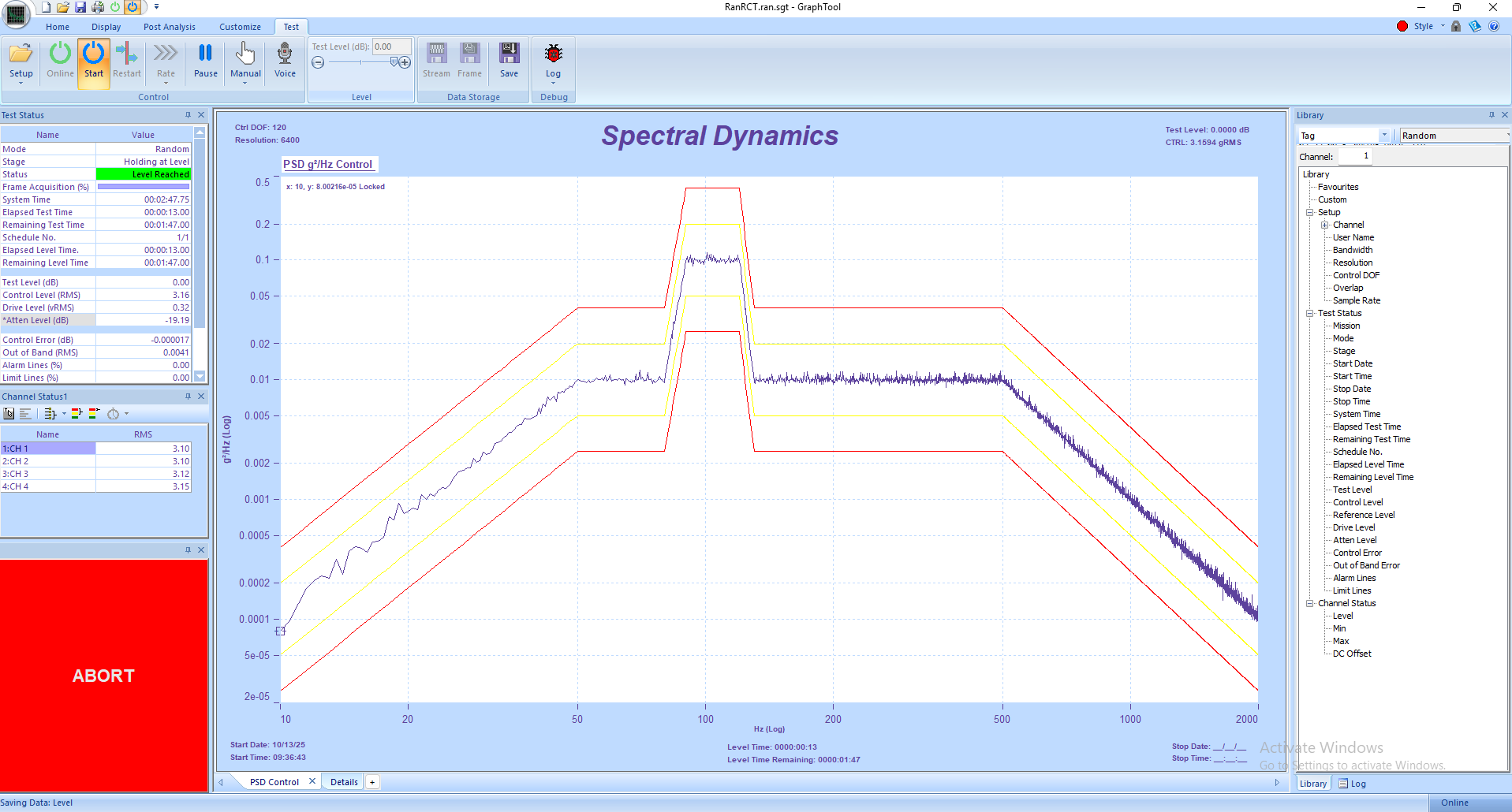
Statistical degrees of freedom (DOF) in random vibration analysis quantifies the confidence in a Power Spectral Density (PSD) estimate by relating it to the number of independent data frames used in the Fast Fourier Transform (FFT). A higher DOF means a more stable and accurate PSD estimate, which can be calculated using a chi-squared distribution to determine the probability that the test is within tolerance. For stationary Gaussian random vibration, DOF equals  2×F, where  F is the number of time-data frames.
 
How it works 
 
•    Random Vibration and PSD: Random vibration involves random oscillations that can only be analyzed statistically. The PSD is a statistical tool that describes the frequency content of this random vibration, showing the power of the signal at each frequency.
•    Averaging and FFT: To get a stable PSD estimate, multiple frames of time-history data are analyzed using the FFT and then averaged.
•    Statistical Confidence: The average PSD is a chi-squared distributed random variable, and the degrees of freedom (DOF) determine how confident you can be in that estimate.
•    The DOF Calculation: For a stationary, Gaussian random waveform, the DOF is calculated as 2×F, where 𝐹 is the number of independent time-data frames.
•    More Frames = More DOF: A larger number of frames leads to a higher DOF and a smoother, more accurate PSD estimate.
•    Overlap and Windowing: Techniques like frame overlap or window functions can introduce redundancy, which affects the DOF calculation. The DOF no longer equals  2×𝐹 in these cases.
•    Probability and Tolerance: The DOF can be used to calculate the probability that the test is meeting its tolerance band, which is important for avoiding over- or under-testing.
 

Related Technical Library


  • Coherence and Phase Matching in Vibration Testing: Essential Parameters for Accurate Control

  • Examples of Data Analysis for Rotating Machinery

  • Importance of Coherence in Vibration Control

  • Overlap Processing in PANTHER Vibration Controllers: Improving Low-Frequency Test Response

  • Rotating Machinery Analysis: Principles, Applications, and Best Practices for Predictive Maintenance

  • Sigma Clipping

  • Sigma Clipping - Ultra Clip

  • Sigma Clipping, Ultra Clip and Kurtosis in Random Vibration Control

  • Statistical Degrees of Freedom (DOF) in Random Vibration Control

  • The Critical Importance of Native 64-Bit Architecture in Vibration Control Systems

  • Transducer Sensitivity Selection for Vibration Control: Optimizing Dynamic Range and Control Quality

  • Understanding Mixed-Mode Vibration Testing: Complete Technical Guide to Sine-on-Random and Random-on-Random Beyond Traditional Testing

  • Understanding Phase and Coherence in Vibration Control Testing

  • Understanding Sine Test Methodologies: Swept Sine, Stepped Sine, and Resonance Search and Dwell

Ready to Evaluate Vibration Control Systems?

Contact Spectral Dynamics to discuss your specific testing requirements and explore how our advanced vibration control solutions can benefit your laboratory.

Request Information


Spectral Dynamics, Inc. is a leading worldwide supplier of systems and software for vibration testing, structural dynamics, and acoustic analysis. Spectral Dynamics' products are used for design verification, product testing and process improvement by manufacturers of all types of electronic and mechanical products.

1500 Wyatt Drive Suite 14
Santa Clara, CA 95054-1522
Tel: (800) 778-8755
sales@spectraldynamics.com
service@spectraldynamics.com

Vibration Controllers

  • Panther  
  • Lynx  
  • Puma  
  • Jaguar

Advanced Solutions

  • Felix - P.I.N.D.
  • Shock Test Systems

Support

  • Contact
  • Product Information
  • Domestic U.S. Service

© 2025 Spectral Dynamics Inc. Privacy Policy

Download our ISO 9001:2015 certificate | Sitemap

Link to Spectral Dynamics Facebook PageLink to Spectral Dynamics Google results.Link to Spectral Dynamics Youtube Page